Client Communication – 5 Mistakes That Ruin Relationships with Investors
Discover the five most common communication mistakes made by construction contractors and learn how to avoid them to build lasting relationships with investors.
admin
January 04, 2026
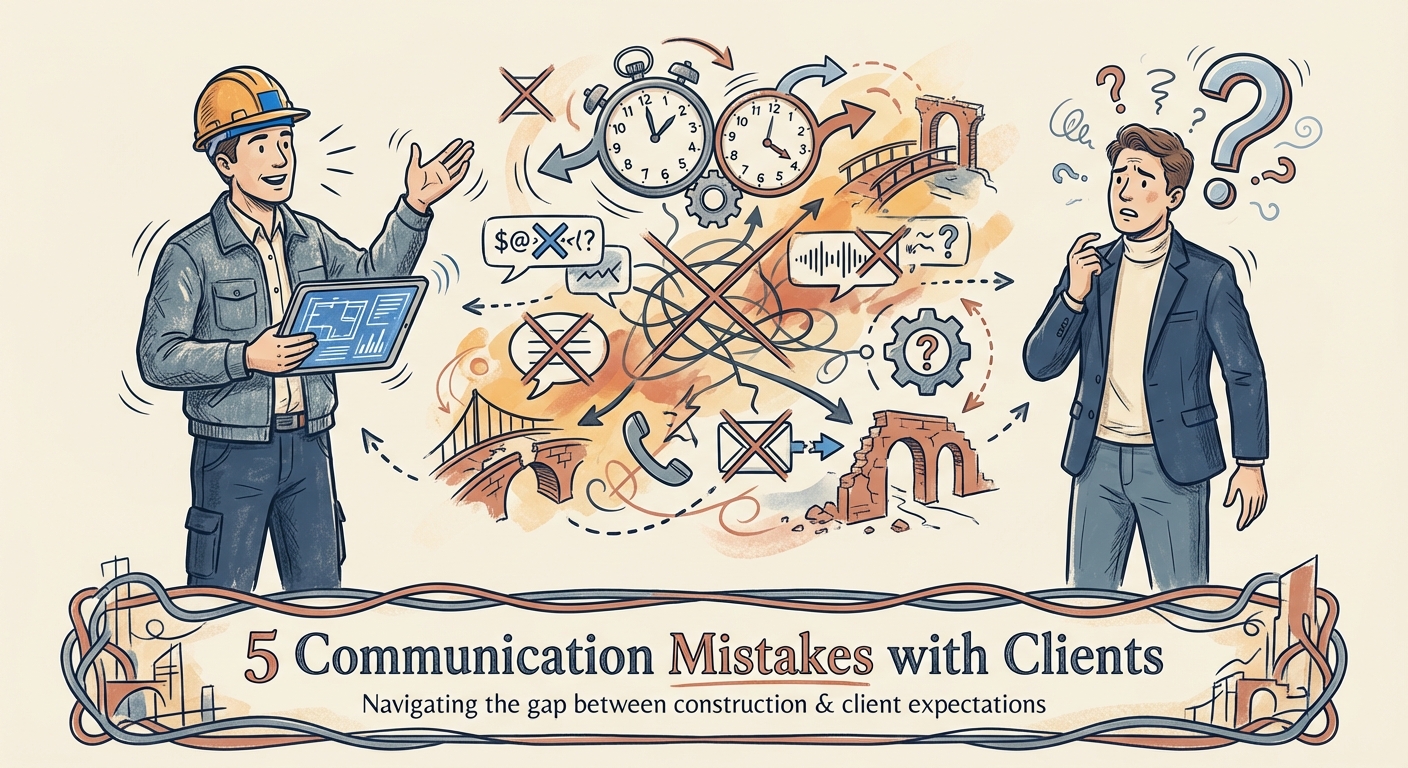
Key takeaways from this article
- Realistic deadlines – better to positively surprise than disappoint
- Regular updates – a client in the dark is an uneasy client
- Simple language – jargon builds distance, not trust
- Taking feedback seriously – small problems grow into big conflicts
- Written confirmations – memory fails, documentation remains
In the construction industry, technical skills are not everything. Many excellent contractors lose clients not because of the quality of their work, but because of how they communicate. A construction project is a process that lasts weeks or months, during which the investor must trust you, understand what is happening, and feel that they are being treated seriously.
One failed conversation, an improperly worded email, or a lack of information about a delay can turn a satisfied client into someone who will leave you a negative online review. Learn about the five most common communication errors and how to avoid them, building lasting relationships with investors.
1. Promising unrealistic deadlines – the trap of optimistic declarations
Every contractor wants to win a contract and make a good impression on a potential client. Therefore, the natural reaction is to present the most favorable offer possible – including in terms of completion time.
The problem is that the construction industry is full of unforeseen circumstances:
Delivery delays
Unfavorable weather
Hidden technical issues
Employee illnesses
When you promise to complete the work in three weeks, but it actually takes five, the client feels cheated – even if the quality of the work is excellent.
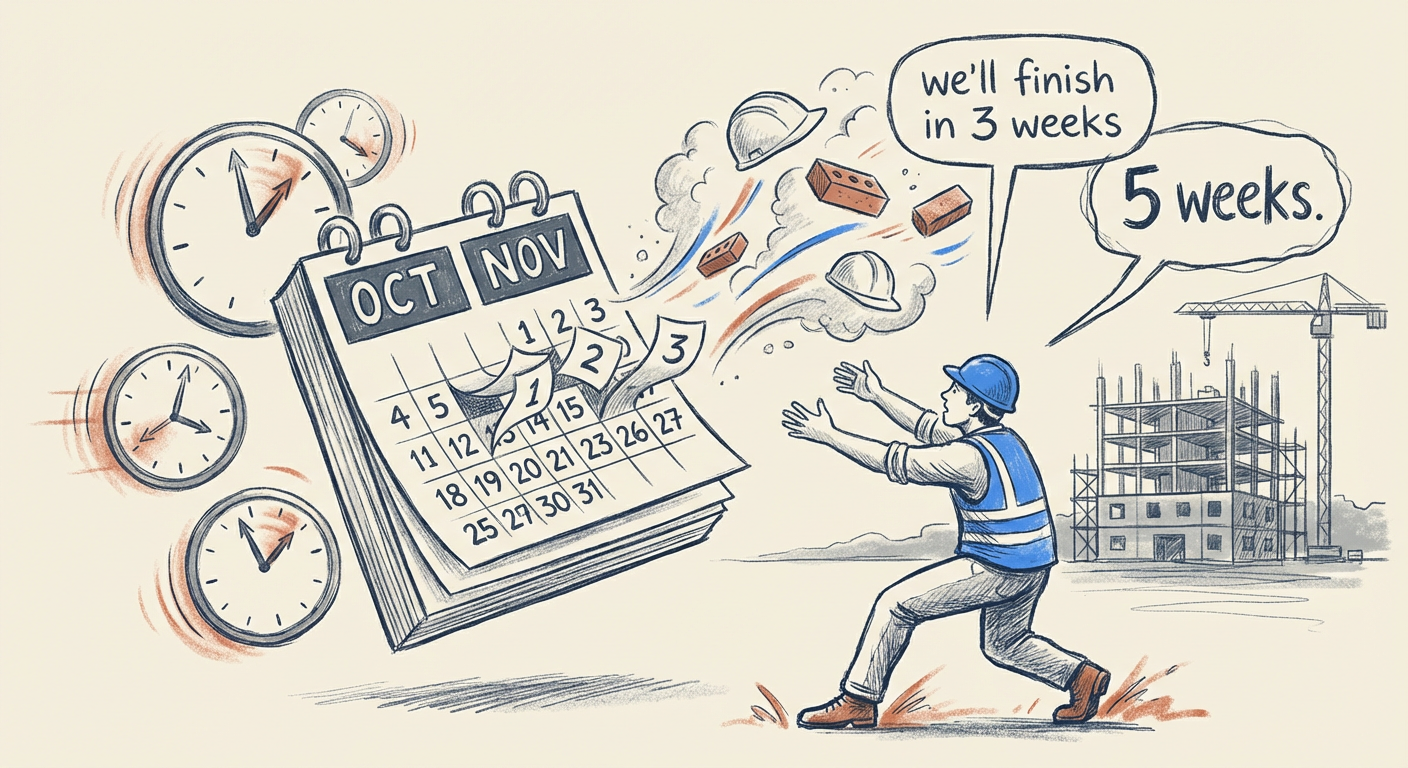
How to avoid this mistake?
💡 Practical rule
Add a 20-30% buffer to your internal calculations. If your industry knowledge suggests a particular job will take about 4 weeks, inform the client of a 5-week timeframe.
This builds the image of a professional who keeps their promises and, in the best-case scenario, positively surprises the client with faster completion.
Also, remember that it’s better to say “I don’t know exactly, but I’ll check and let you know” than to guess a date you can’t meet.
2. Lack of regular updates – a client in the dark is an uneasy client
Many contractors make the mistake of thinking that since the work is proceeding according to plan, there’s no need to inform the client. In reality, an investor who doesn’t know what’s happening on their construction site starts imagining the worst-case scenarios:
"Why hasn't the crew been here for three days? Is everything really okay? Has the contractor disappeared with the deposit?"
It’s not about spamming the client with messages every few hours, but about maintaining consistent, predictable communication.
Best practice: Establish a reporting rhythm
| Project scale | Frequency | Format |
|---|---|---|
| Small renovation | 2x per week | SMS/phone |
| Medium project | Weekly | Summary email |
| Large investment | Every 2 weeks | Meeting + online construction log |
📸 Pro tip
For larger investments, it's worth maintaining a simple online construction log or a messenger group where you regularly post photos of the work progress.
A client who knows what’s happening is patient and trusting. A client who has to call and ask about progress gradually loses patience and trust.
3. Technical jargon – a simple word means more than a specialized term
An investor is not a builder. They don’t know technical terminology, don’t understand material specifications, and don’t know why “rigid reinforcement” differs from “flexible reinforcement.”
When you try to explain something to them using professional jargon, they probably nod their head, not understanding anything, and leave with the impression that you are speaking to them condescendingly.
Examples of translating jargon into simple language
| ❌ Technical jargon | ✅ Simple language |
|---|---|
| "Vertical foundation waterproofing using a coating method" | "A special layer that will protect the walls from ground moisture" |
| "Install the lintel with steel anchors" | "We will reinforce the window opening with steel elements to prevent the wall from cracking" |
| "Error in static calculations for beam PB-3" | "We had to recalculate the strength of this load-bearing beam" |
An investor who understands what you are doing and why is more willing to accept your decisions and collaborates better in resolving any potential problems.
4. Ignoring minor concerns – small problems become big conflicts
Minor client comments arise on construction sites:
- “This door seems to squeak a bit”
- “This tile could be laid a bit more evenly”
- “The color of this paint seems different from the sample”
Many contractors dismiss such comments, considering them the pickiness of an investor who doesn’t know what they’re talking about. However, it is precisely at these moments that the most serious conflicts arise.
⚠️ Snowball effect
A client whose minor concern has been ignored begins to scrutinize everything more closely, looking for confirmation that "something is wrong."
Rule: Treat every concern seriously
Even if you think the client is exaggerating:
- Listen to them – make them feel important
- Acknowledge – “I understand your concerns.”
- Discuss solutions – “We can fix this by…”
Often, it turns out that a minor correction costs very little and diffuses tension that would otherwise build up throughout the construction period.
Remember: For you, this construction is one of many. For the investor – often the biggest investment of their life. Their stress and emotional involvement are understandable.
5. Unclear verbal agreements – memory fails, documentation remains
“We agreed that this would be included in the price”, “You said we could choose more expensive tiles”, “The verbal agreement was that we would change this stage.”
There is probably no contractor who hasn’t encountered a situation where a client has forgotten verbal agreements or interprets them completely differently. Human memory is fallible, and in stressful situations, it can play tricks on both sides.

Rule: Confirm everything important in writing
It doesn’t have to be an official addendum to the contract – it’s enough to have:
A summary of the conversation sent after the meeting
💬 Message
A note in a messenger app confirming the agreement
✍️ Note
A short note signed by both parties
Example email after a meeting:
Subject: Meeting Summary - Kwiatowa 15 Construction
Thank you for today's meeting. To summarize our agreements:
- We are changing the styrofoam thickness to 15 cm
- Settlement will be made via a separate invoice
- Completion date: by March 15th
Please confirm if everything is correct.
Such an email not only protects your interests but also builds the image of a professional who values clarity and order.
Summary – communication is an investment, not a cost
Building relationships with investors requires time and attention, but it pays off many times over:
| Benefit | Result |
|---|---|
| 🗣️ Referrals to friends | New clients without advertising costs |
| ⭐ Positive online reviews | Higher search engine ranking |
| 🔄 Repeat business for future projects | Stable, predictable revenue |
| 😌 Fewer conflicts | Saving time and nerves |
Communication is not an add-on to a contractor’s work, but an integral part of it, determining the company’s success.
Ensure professional communication with BuildHub AI
Construction project management tools help maintain order in documentation and client communication.
Try demo →This article is part of a series on professional construction company management. Follow our blog to discover more practical tips.
Related Articles

Construction Recruitment: How to Find Workers Who Stay
Practical recruitment guide for construction. Where to find skilled workers, ho…
5 Mistakes Contractors Make When Automating Processes
Digitalization can be both salvation and curse. Learn from others' mistakes and…
Ready to optimize your construction business?
Join hundreds of construction companies using BuildHub AI